
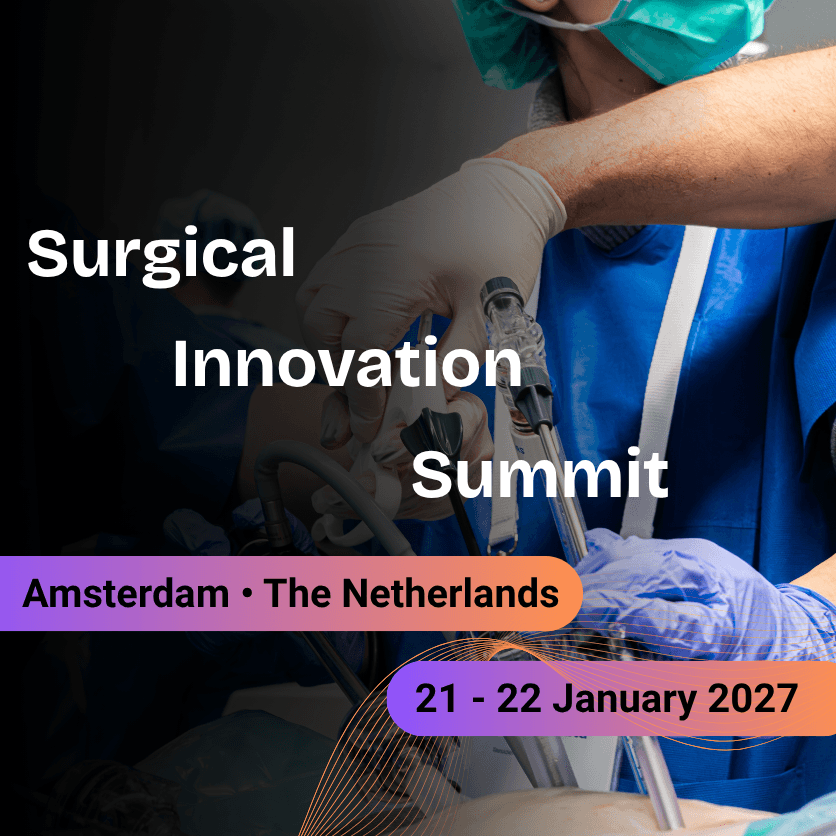
Technology should never be adopted because it is new. It should be adopted because it improves patient outcomes, supports surgical teams, enhances workflow, or reduces environmental impact. This symposium will explore how innovation can help surgeons make better decisions before, during and after surgery. Every innovation should demonstrate added value for at least one of these four domains:
- Patient outcomes
- Surgical team
- Workflow and efficiency
- Environmental sustainability
Please note that this programme is still subject to change
Thursday 21st January 2027
Location: Olofskapel
| 13.00 – 14.00 | Joint lunch, registration and welcome |
| Session 1: How AI can support surgeons throughout the patient journey | |
|---|---|
| 14.00 – 14.15 | Can AI democratise surgical quality worldwide? – Martin Wagner (Germany) |
| 14.15 – 14.30 | Real-time anatomy recognition and intraoperative decision support – Jennifer Eckhoff (Germany) |
| 14.30 – 14.45 | The AI Act, ethics and responsible implementation in surgery – Deena Harji (UK) |
| 14.45 – 15.00 | AI in the surgical pathway – Pedro Gouveia (Portugal) |
| 15.15 – 15.30 | The role of AI in producing guidelines and recommendations: present and future – Gaetan Romain Joliat (Switzerland) |
| 15.30 – 15.45 | Discussion |
| 15.45 – 16.15 | Coffee break |
| Session 2: Seeing more, operating better Chairs: Michele Diana (Italy) & Mehmet Ayhan Kuzu (Türkiye) | |
|---|---|
| 16.15 – 16.30 | New image guided surgical techniques – Alex Vahrmeijer (The Netherlands) |
| 16.30 – 16.45 | Elevator pitch Y-ISFGS initiative – Phoebe Collins (UK) |
| 16.45 – 17.00 | Surgical navigation during surgery – Theo Ruers (The Netherlands) |
| 17.00 – 17.15 | Training in the high-tech era: opportunities and challenges of AI, AR, VR – Jim Khan (UK) |
| 17.15 – 17.30 | Fluorescence-guided surgery and sentinel nodes in rectal cancer – Philippe Rouanet (France) |
| 17.30 – 17.45 | Enhanced pre and intraoperative visualisation in gastro-intestinal and abdominal wall surgery – Salvador Morales Conde (Spain) |
| 17.45 – 18.00 | Discussion |
| 18.00 – 20.00 | Joint Welcome reception |
Friday 22nd January 2027
Location: Olofskapel
| Session 3: Which new technologies truly improve patient care? Chairs: Hans Fuchs (Germany) & Salvador Morales Conde (Spain) | |
|---|---|
| 09.00 – 09.15 | Current robotic platforms innovation or evolution? Training programme – Benjamin Babic (Germany) |
| 09.15 – 09.30 | Emerging surgical technologies – Antonino Spinelli (Italy) |
| 09.30 – 09.45 | Digital twins and computational modelling for surgical planning – Francesco Marzola (Italy) |
| 09.45 – 10.00 | New and innovative prosthetics materials and sutures – Frederik Berrevoet (Belgium) |
| 10.00 – 10.30 | Panel discussion: How should surgeons decide whether a new technology deserves clinical adoption? – Patricia Tejedor (Spain), Geerard Beets (The Netherlands), Nicole Bouvy (The Netherlands), Maciej Smietanski (Poland) |
| 10.30 – 11.00 | Coffee break |
| Session 4: Technology enabling better clinical decisions | |
|---|---|
| 11.00 – 11.15 | Molecular surgery for colorectal cancer – José Perea (Spain) |
| 11.15 – 11.30 | Organ preservation versus radical surgery: where are the new boundaries? – Geerard Beets (The Netherlands) |
| 11.30 – 11.45 | Building multimodal models for decision making – Regina Beets-Tan (The Netherlands) & Elleke Dresen (Belgium) |
| 11.45 – 12.00 | Local treatment methods for metastases: heat, cold, RT etc…. – Hassan Malik (UK) |
| 12.00 – 12.15 | Rethinking rectal cancer surgical pathway: The SMART* programme (*Sustainable Mini-invasive Approach Rectal cancer Treatment) – Quentin Denost (France) |
| 12.15 – 12.30 | AI to predict the risk of lymph node metastasis in T2 colorectal cancer – Caterina Foppa (Italy) |
| 12.30 – 12.45 | Can AI help to predict when preventive mesh positioning to avoid incisional hernia is indicated |
| 12.45 – 13.00 | Discussion & closure |
